GROUND · I
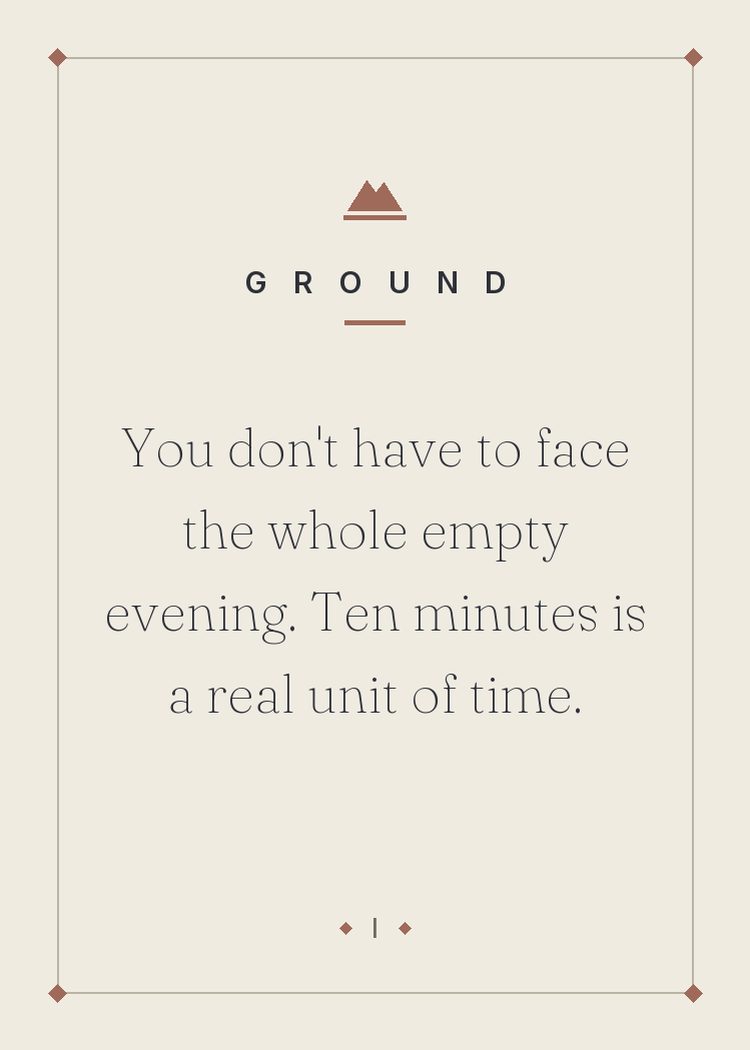
Overwhelm is partly a time problem: under acute stress the mind tries to process the whole empty future at once, and capacity collapses. Crisis stabilization uses deliberate time-shrinking — cut the horizon until it fits what you can actually carry. Ten minutes is small enough for a grieving nervous system to hold, even an evening that echoes. Chain the ten-minute segments and the evening passes without ever being faced whole.
Voices — this card, in use
Teaching vignettes: illustrative voices showing the practice applied. The living candle wall grows below.
Carla — 'the first evening without Duke I just did ten minutes at a time. dishes, then the porch, then ten more. the evening passed without me facing it whole.'
Sam — 'ten minutes is exactly the length of the walk we used to do to the corner. I can do one walk-length of anything.'
Whatever is coming up
This room is open every time — tonight, the anniversary, years from now. What's here right now?
The practice
Set a timer for ten minutes at the hour that hurts most — walk time, dinner time. One tiny task inside it. When it rings, choose the next ten. The empty evening never has to be faced whole.
When it's yours
If it's early daysThe first feeding times and walk hours are the steepest. Ten minutes is the correct dose for each one.
If it's been a long timeYears on, the tool still works on ambush hours — a bark outside, a vet reminder in the mail.
If the ending was hardAfter a hard last day, the mind replays in hours, not minutes. Shrink to ten. The replay can wait; it always keeps.
Sit with this
Which hour of the day is heaviest without them — and what could fill just ten minutes of it?
Grief literacy
Term to know: Temporal chunking — shrink the horizon until it fits your capacity. Ten minutes is a survivable size.
If this card holds you
This room doesn't expire. Grief isn't a one-time event — anniversaries, ambushes, the good years, the hard ones — and the card in your hand is a permanent key. Come back for whatever is coming up.
This card lives in the deck — 52 companions, on a nightstand near the people you love. Buy the physical deck — $35.00 · free US shipping